


Business

Why parents make outstanding project managers: how parenting experience creates unmatched pm skills

AuthorCMG
Date18 May 2026
Reading time5 minutes

People often assume parenting and project management are in a fierce battle for the title of “Who will drain my energy faster today?” Parenting and project management are closely aligned, as both develop essential skills.

Parenthood is comparable to managing a demanding agency around the clock. Parents adapt to shifting requirements, unclear expectations, and unexpected challenges. In doing so, they continuously refine the skills that define exceptional marketing project managers. The first of these is multitasking and time management.


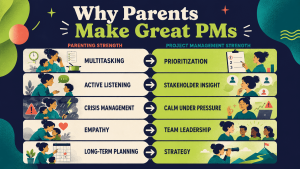
1. Multitasking & Time Management: If You Can Get a Child Ready for Daycare, You Can Launch a Global Campaign

Picture a typical morning.

One child cannot find a sneaker. Another one refuses to wear a jacket, insisting, “I don’t feel cold.” Third is crying because their sandwich looks too smiley.
Meanwhile, the parent coordinates these challenges much like a digital strategist managing multiple priorities and last-minute client requests.

Why this makes PMs better:

  • Prioritization becomes instinctive.
  • They know which tasks need attention within the first two minutes of a crisis.
  • They understand plans can unravel instantly — but they also know how to rebuild them quickly.

Marketing reality check

If you have managed to prepare breakfast, dress a child, locate a missing toy, and still join an early meeting on time, then coordinating multiple campaign workstreams becomes significantly more manageable. The next essential project management skill is active listening and reading between the lines.

2. Active Listening & Reading Between the Lines: Parents Are Micro Emotion Detectors

When a child says, “I don’t like this preschool,” it can mean at least 17 different things — from someone sitting in their spot to a fight with a friend.

Parents learn to analyze tone, facial expressions, and subtle cues.

Clients and teammates exhibit similar behaviors, though often in more subtle ways.

Why this makes PMs better:

  • They decode what a client really means by “Maybe we should slightly shift direction.”
  • They sense when a designer is emotionally five seconds from snapping.
  • They intuit the hidden needs of the audience, the market, users, and even the CEO.

Marketing example:

A team says, “Yep, the brief is totally clear.”
A project manager who is also a parent recognizes the same subtle cues as when a child insists, “I didn’t hide anything,” but their expression reveals the truth. Next, we move from decoding emotions to managing fast-paced crises.

3. Crisis Management: Parents Are Experienced in Managing Escalations

Supermarket meltdowns.

Lost toys three minutes before leaving the house.
A sudden fever the night before an important meeting.

After managing these situations repeatedly, urgent requests become far less daunting.

Why this makes PMs better:

  • They assess situations incredibly fast.
  • They make pressure decisions without theatrics.
  • They know panic is never a strategy.
  • They can resolve a campaign crisis with the same composure used to manage household disagreements.

Marketing example:

SEO rankings drop overnight, and everyone panics.
A project manager who is also a parent remains calm, much like when a child falls and the parent assesses the situation before reacting.

4. Empathy & Emotional Intelligence: Parenting Provides Unmatched Leadership Training

Parenthood requires:

  • recognizing emotions before they’re spoken
  • diffusing tension
  • nurturing growth
  • providing support
  • setting boundaries with love and firmness

It’s basically an MBA in leadership.

Why this makes PMs better:

  • Teams thrive when led by someone who truly “gets” them.
  • Negotiations are easier when you hear what’s really bothering the client.
  • Empathy-driven campaigns perform better — and parents are experts in human emotions.

Marketing example:

If you can persuade a child to wear boots in July, you can also persuade a client to change a headline. Long-term planning is another area where parent project managers excel. Let us examine why parenthood is a long-term commitment.

5. Long-Term Planning: Parenthood Is a 20-Year Project

Parents constantly think several steps ahead:

  • “If I give in now, it’ll be harder later.”
  • “If I skip routine today, chaos is coming.”
  • “If they study today, tomorrow is easier.”

This is an example of strategic thinking.

Why this makes PMs better:

  • They excel with clear goals and milestones.
  • They think like brand managers: every decision has long-term consequences.
  • They balance today’s results with tomorrow’s reputation.

Marketing example:

Understanding that a short-term solution may lead to long-term challenges, such as a candy bar providing brief peace but resulting in later chaos, helps project managers recognize that quick campaigns may harm the brand over time.

Conclusion: Parenting as a PM MBA Program

Parent PMs bring:

  • remarkable resilience
  • deep understanding of people
  • improvisation skills
  • strategic thinking
  • stress-proof multitasking
  • the ability to use humor constructively

Everything marketing demands — they practice daily.

Parenthood does not diminish a project manager’s abilities.
On the contrary.

It develops professionals who remain calm, understand people, and solve problems efficiently, as they manage complex situations at home that require immediate solutions. As a result, parent project managers often match or surpass their peers, bringing valuable real-world experience to marketing and other fields.